Best RTP Slots 2026: Sample Size, Hit Rate and Measured RTP Across 163 Tests
Anyone who has run an A/B test on a mailing list knows the trap: a variant looks like the winner after a few hundred sends, then sinks back once the numbers grow. Slot returns behave in much the same way. The best RTP slots ranking on Slotester orders tested games by what they returned across logged sessions on demo servers run by each provider, shows the declared RTP alongside, links a free demo of every game on its review page, and reports each result with its uncertainty attached.
The best RTP slots table in one sentence: a live list of slot games sorted by measured RTP, meaning total wins divided by total bets over every logged run of each game, with the declared figure reported by the demo server and an approximate 95% interval beside it. As of 20 October 2026 it draws on 163 tests: 2,820,000 ordinary rounds spread over 282 runs, plus 10,200 bought bonuses, and it recalculates whenever a new test is published.
That makes it a neat case study in reading results honestly: why 10,000 rounds is still a small sample, why hit rate tells a different story from RTP, and how the top rows should be read before anyone draws conclusions from them.

What exactly does the ranking measure?
The ranking measures realised return, not advertised return. For every game, Slotester Lab plays one continuous series of ordinary rounds at a fixed bet on the official demo server of its studio, with default settings and every server response logged. The measured RTP is the sum of logged wins over the sum of logged bets; bought features are counted separately so they do not distort the base figure.
The rig is Python software that uses the native protocol of each server, so every logged round is a real server outcome rather than a simulation. Before a review goes out, the balance after every round is reconciled with the server, free-spin totals are cross-checked, and a person signs off only after matching the draft, figure by figure, to the logged data. Studios as different as Nolimit City, Blueprint Gaming, Pragmatic Play, Hacksaw Gaming, Play'n GO, BGaming, Thunderkick, Quickspin and Relax Gaming share one table because the procedure never changes from game to game.
Why does a 10,000-round test still leave a wide interval?
Because slot returns are dominated by rare, large rounds, in the same way that the revenue of a campaign can hinge on a handful of big orders. Ten thousand rounds sounds like plenty, but if most of the return arrives in a few bonus rounds, the sample holds only a few dozen of the events that matter, and one more or one fewer changes the result sharply.
In email the fix for a noisy test is a bigger list. In the lab it is a retest: another complete session of the identical build, after which the headline figures merge every run into one longer series. The band narrows as rounds accumulate, although it still describes those particular sessions rather than the next one.
Karen Maneater from Nolimit City shows the extreme. Its single run of 10,000 rounds on 15 October 2026 measured 102.80% against 96.00% declared, but the approximate 95% band stretches from 11.04% to 194.56%, the widest in the lab at 183.5 points. The headline number is accurate as a record of that session and close to useless as an estimate on its own. The band itself is a normal approximation: the average return per round, plus or minus 1.96 times the standard deviation scaled down by the square root of how many rounds were played. Rare payouts make it imperfect, and it says nothing reliable about the return of the next session.
Hit rate is the open rate, RTP is the revenue
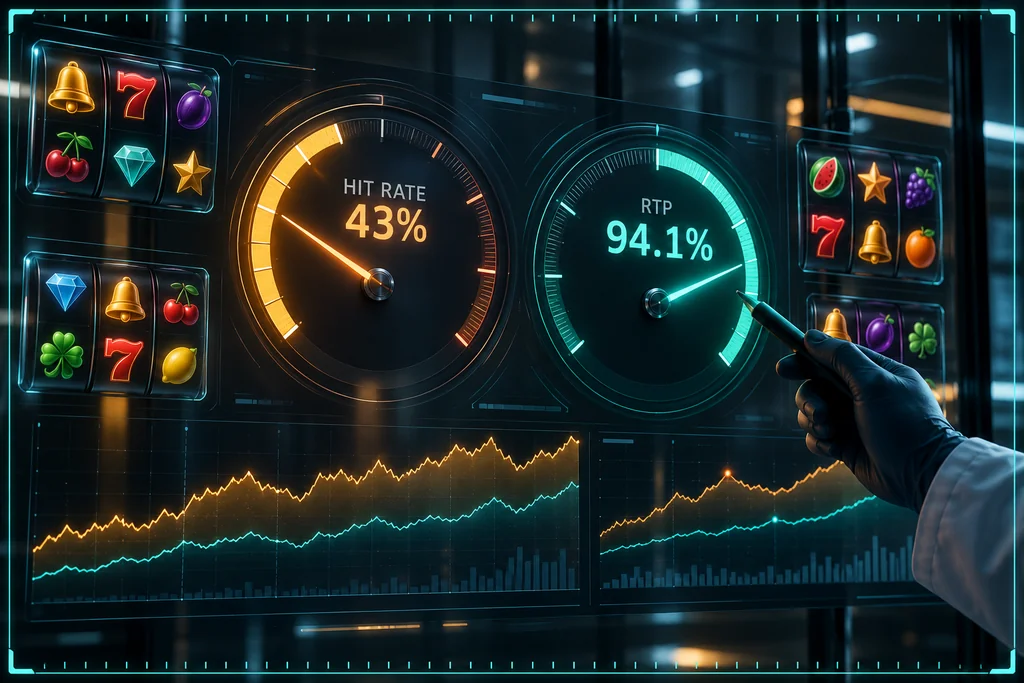
Hit rate is the share of rounds that pay anything, even a fraction of the stake, and like an open rate it measures activity rather than value. Across the lab it ranges from 9% to 43%, and it says remarkably little about where a game lands on RTP.
Sweet Bonanza from Pragmatic Play has one of the highest hit rates in the register at 42.86%, yet over 50,000 rounds in five runs it measured 94.11% against 96.49% declared, which leaves it 93rd. Eye of Horus Megaways from Blueprint Gaming sits at the other end with a 9.44% hit rate and the longest dry run in the lab, 114 spins without a win, and still measured 108.99% against 95.49% over 30,000 rounds, good for tenth place. It also triggered a natural feature roughly once every 109 rounds, so its return came through bonus rounds rather than through a steady drip of small hits.
The lesson carries straight over from campaign reporting. A metric that moves often is not the metric that pays, and a variant with a low open rate can still deliver the most revenue if its few conversions are large. Reading the hit rate and the measured RTP together, rather than either one alone, is what turns the ranking into a useful picture of how a game actually behaves.
Four tests side by side: sample size against band width
The table puts four results next to each other, the way a campaign report lists variants with their send counts. The pattern is clear: bigger samples tighten the band, but volatility matters as much as volume.
| Game | Rounds (runs) | Hit rate | Measured RTP | Declared RTP | Approx. 95% band | Provider |
|---|---|---|---|---|---|---|
| Karen Maneater | 10,000 (1) | 24.41% | 102.80% | 96.00% | 11.04% to 194.56% | Nolimit City |
| Twilight Princess | 10,000 (1) | 20.44% | 110.86% | 96.08% | 84.84% to 136.88% | Pragmatic Play |
| Eye of Horus Megaways | 30,000 (3) | 9.44% | 108.99% | 95.49% | 81.06% to 136.92% | Blueprint Gaming |
| Sweet Bonanza | 50,000 (5) | 42.86% | 94.11% | 96.49% | 88.32% to 99.90% | Pragmatic Play |
Two single-run tests of equal length produced bands of very different widths, because the largest round of Karen Maneater reached 4,608x the stake while Twilight Princess, a medium-volatility game, paid within a narrower range. Sweet Bonanza, with five runs and the busiest hit pattern of the four, has the tightest band, and it is the only one in the table that measured below its declared figure.
How does the table update when a new test lands?
The ranking behaves like a live campaign dashboard: each newly published test enters automatically and the order recalculates on the spot. Titles already in the table move only after a fresh run, and a re-run joins the earlier ones in a single pooled series while the review keeps the figures, band and log of every run separately in its test record.
That is why every figure here carries a date. Twilight Princess holds fifth place on a single run from 15 September 2026; another run could lift it or drop it, and the review would then show both sessions side by side. Nothing in the table is adjusted by hand, so a poor measurement stays exactly where its numbers put it, the way an honest report leaves an underperforming variant in the results instead of quietly deleting it. Every number in this article therefore reflects the register as it stood on 20 October 2026, and any of them may shift after the next retest.
Is a game above its printed RTP a winning variant?
No. A measured return above the declared value means the sample caught one or two large rounds, not that the game pays more by design. Across the 163 tests, 73 games finished above their printed figure and 90 below, and in 153 of them the declared value sits inside the approximate 95% band, which is the expected spread when games run on their stated maths. A result far outside its band is treated the way a suspicious variant would be: as a reason to run the test again, not as a finding.
The aggregate tells the same story. The average measured return is 95.9%, set against 96.38% for the declared figures, roughly a 4.1-bet edge per 100 stakes for the game over a long run. The measured figures describe finished sessions on demo builds; no casino is bound to repeat them, and Slotester says as much on its own pages.
What can a player learn from the RTP ranking on slotester.com?
- How wide can the uncertainty on one test be? The single run of Karen Maneater left a band from 11.04% to 194.56%, the widest in the lab.
- Does a high hit rate mean a high RTP? No: Sweet Bonanza hit on 42.86% of rounds and still measured 94.11% against 96.49% declared.
- Can a game that rarely pays rank near the top? Yes: Eye of Horus Megaways hit on 9.44% of rounds and measured 108.99% over 30,000 spins.
- Can one short test put a game in the top five? Twilight Princess sits fifth on one 10,000-round run at 110.86% against 96.08%.
- How long can a dry spell last? The longest stretch without a win in the register is 114 spins.
- How many games finished above their printed RTP? 73 of 163, with 90 below.
- How often is the printed figure inside the measured band? In 153 tests out of 163.
- How big is the data set? 163 tests, 282 runs and 2,820,000 ordinary rounds, with 10,200 bought features on top, as of 20 October 2026.
- When does the order change? Each time a test is published, and for listed games only after a re-run.
- Where does the demo of each game live? On its review page, free to open, running on virtual credits and needing no registration.
- Can the numbers be verified? Each run publishes its logs with SHA-256 checksums, and the CSV reproduces the measured RTP.
Segmenting the list: other columns worth sorting
Measured RTP is the default sort, but like any decent dashboard the list of best RTP slots can be cut in other ways. The buttons above the table reorder it by:
- declared RTP, for comparing what the demo server reports across games;
- hit rate, for how often a round returns anything at all;
- max win, for the largest single round logged in testing;
- bonus value, what a bought feature paid back on average relative to its cost, where a game sells one.
For anyone hunting the highest RTP slots by printed figure alone, the declared sort answers that in one click. The table of four tests above is the reminder that the printed figure and the measured return are separate metrics, and that a dashboard sorted on one says little about the other.
The bonus rate column uses the lab's own unit, bHz: features that arrived without a purchase in every 1,000 ordinary rounds; at 5.2 bHz, that means roughly one feature every 192 rounds. Being a rate and not a tally, it lets a 10,000-round test sit beside a 50,000-round one on equal terms. The same logs also feed separate rankings for bonus value and maximum wins, and the front page of Slotester Lab, https://slotester.com/, brings everything together: the register of all 163 tests with a sortable table of measurements, every ranking and the research articles on declared versus measured RTP.
Checking the raw export yourself
Every review offers three downloads per run: a plain-text log of every spin, an ordinary-round CSV and a gzipped JSONL archive holding rounds, purchases and raw server traffic, each published with a SHA-256 checksum. Adding up the wins in the CSV and dividing by the total of the bets gives back the measured RTP of the run, stitching every run's CSV together gives back the pooled number, and the checksum confirms the file has not changed since publication. If a recomputed figure ever differs from the page, sending the review link to the lab triggers a comparison of the public export with the internal journal.
One more detail matters before comparing the table with a game met elsewhere. Many slots ship in several RTP versions built on one maths model, and the declared column holds the return version that the demo server announced when the session opened. If the information screen of a game shows a lower figure, the measurements apply to a better version than that copy. The quickest way to see the game itself is the free demo on its review page, which runs in the browser on play credits and needs no account.

A test budget, not a growth plan
Slot games are for adults aged 18 and over, and they are entertainment with a cost, never a channel for income. A measured RTP, however high, is a record of sessions that already happened and not a promise about the next one. The demo on each review page uses virtual credits and is the natural place to explore features and pace. For anyone playing with money, the discipline of a good experiment applies: fix the budget and the time box before starting, stop when either runs out, never extend the test to win back losses, and take a break whenever play stops being fun.