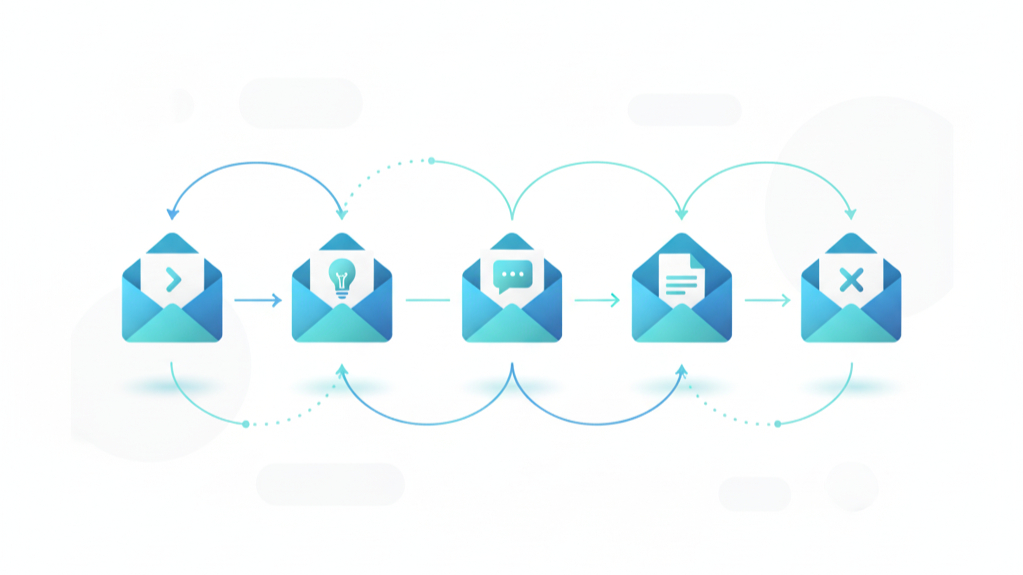
The modern inbox is a battleground for attention, and without a strategic follow-up process, your initial outreach is likely to fail. Did you know that 80% of sales require 5 follow-up attempts after the initial meeting? Sending just one email is often not enough to capture the attention of busy professionals, job recruiters, or potential clients. Follow-up emails are the essential communication bridge that moves a conversation from an initial introduction to a decisive action—whether that’s closing a sale, securing an interview, or getting a vital response. For professionals in sales, marketing, and networking, mastering the follow-up is not an option; it’s a necessity for success. Research consistently shows that most organizations give up after just two attempts, leaving immense conversion potential on the table. This post dives deep into the anatomy of the perfect follow-up email, drawing on insights from communication experts, behavioral science, and successful case studies. Learn how to craft compelling, non-intrusive follow-ups that convert indifference into engagement. Want to improve your response rates by over 20%? The secret lies in a strategic, multi-step follow-up cadence, supported by a powerful Email Marketing Service. This comprehensive guide provides a roadmap to creating follow-up emails that get opened, read, and acted upon.
Key phrases for this guide include: “Follow up email best practices,” “How to write a follow up email,” and “Email follow up strategy.”
1. Defining the Follow-Up Email: More Than a Nudge
A follow-up email is a strategic message sent after an initial contact, meeting, or event, with the clear purpose of prompting a response or advancing a specific goal. It is not merely a polite reminder; it’s an opportunity to provide additional, context-aware value, reiterate your unique proposition, or simply confirm the next concrete steps. Effective follow-ups are the backbone of successful outreach campaigns, ensuring your message doesn’t get lost in the recipient’s overflowing inbox, which often contains hundreds of unread messages. The critical differentiator is the addition of new context or value in each subsequent email, thereby justifying its presence in the recipient’s life. This is especially true when dealing with challenging outreach like cold email campaigns, where trust and attention are scarce resources. Furthermore, securing these contacts often starts with optimizing lead generation using expertly crafted Signup Forms.
The Four Key Types of Follow-Up Emails and Their Value Propositions
- **Post-Meeting/Interview Follow-Up (Relationship Building):** Expresses immediate gratitude, reiterates key agreements or takeaways, and confirms the next specific action item. **Value Add:** Demonstrates organization, reinforces the professional relationship, and highlights attention to detail. Goal: Build rapport and confirm mutual commitment, leading to the next stage of engagement.
- **Sales Follow-Up (Opportunity Advancement):** Sent after a proposal, quote, or demo. Re-engages the potential client, offers compelling case studies, industry reports, or proactively addresses potential pricing or technical objections. **Value Add:** Overcomes hesitation by providing social proof, risk mitigation, or competitive comparison data. Goal: Secure the next call or close the deal.
- **Networking Follow-Up (Long-Term Value):** Continues a professional relationship, perhaps sharing a relevant industry article, a useful resource, or asking for non-transactional advice. **Value Add:** Maintains connection by providing non-transactional, helpful content without a direct immediate ask. Goal: Maintain connection and build a long-term professional network.
- **No-Response/Cold Follow-Up (Elicit a Decision):** A gentle ‘touch base’ with a fresh angle, often including a time-sensitive incentive or the final, polite “breakup email” as the last attempt. For context, you can learn more about What is a Cold Email here. **Value Add:** Respects their time while offering an easy out, often prompting a response either way. Goal: Elicit a definitive response (yes, no, or not now).
The Power of the Sequence and Cadence: Relying on a single email is a losing game. Successful campaigns leverage sophisticated sequences (or cadences) where each email is highly targeted and builds upon the last, offering a different piece of value or addressing a new objection. This multi-touch approach is scientifically proven to work because it increases brand familiarity (the Mere-Exposure Effect) and catches the recipient at the precise moment their attention is available. Industry data consistently shows that the optimal outreach cadence involves 5 to 7 touches over a period of 28 days. This is why platforms like useinbox offer specialized Email Automation Guide tools to manage these complex, spaced-out sequences flawlessly.
2. The Golden Rules of Timing, Cadence, and Automation
Timing is arguably the most crucial factor in follow-up success. Sending an email too soon seems desperate and unprofessional; sending it too late means your message is forgotten and irrelevant. The ideal timing is highly situational, but there are established norms that maximize open and response rates. Monitoring your performance is key to optimization—A/B testing different send times and days is critical—which is where effective Reporting and Analytics tools become indispensable. Always ensure your emails are sent according to the recipient’s local timezone, which significantly boosts engagement.
Optimal Follow-Up Timing by Scenario
| Scenario | Optimal Timing | Reasoning |
|---|---|---|
| Post-Meeting/Interview | Within 24 hours (ideally 4-6 hours) | Strike while the memory is fresh and decision-makers are compiling notes. Shows respect for time. |
| Sales Proposal/Quote | 2-3 business days after sending | Gives them adequate time to review complex documents without feeling rushed; allows you to address immediate questions. |
| Initial Cold Email | 48-72 hours after the initial send | The first follow-up often has the highest reply rate—it serves as a gentle re-bump before they forget the context. |
| Abandoned Cart (E-commerce) | Within 1-2 hours (with subsequent emails at 24 and 72 hours) | This is a high-intent, high-urgency scenario where fast action, often with an incentive, recovers revenue. |
Implementing a High-Converting 5-Part Cadence
A successful long-term follow-up strategy requires more than just three touches. Research indicates that the majority of successful sales conversions (often 80%) occur between the fifth and twelfth interaction. A robust sales cadence follows this optimized, spaced-out pattern:
- **Touch 1 (Day 1 – Initial Contact):** Focus on the core Value Proposition and personalization.
- **Touch 2 (Day 3 – Quick Re-bump):** The first follow-up. Keep it short, and add a relevant piece of content (blog, case study) or a specific reference to their company.
- **Touch 3 (Day 7 – Objection Handling):** Address a common objection related to cost, implementation, or competition. Offer a solution-focused insight.
- **Touch 4 (Day 14 – Social Proof/Risk Reversal):** Share a testimonial, a powerful statistic, or offer a risk-free trial. Link to your Customer Reviews page.
- **Touch 5 (Day 28 – The Breakup):** The final, polite message to elicit a clear Yes or No response. This is often the second-highest performing email in the sequence.
To manage the complexity of this schedule, leverage the automation tools of your email platform. For instance, **Auto-Resend** functionality can automatically send a second version of a key email to recipients who did not open the first one, significantly boosting your overall open rates without manual effort. Studies show that persistence pays off, with 60% of customers saying ‘yes’ only after the fifth ‘no’. Key phrases: “email follow-up cadence,” “best time to send follow-up email.”
3. Crafting High-Converting Follow-Up Content: The Value Exchange
The content of your follow-up is what separates the helpful from the annoying. Every email in the sequence should aim to provide new context or value, not just re-send the original pitch. Remember the mantra: Value first, ask later. The visual appeal and structure matter too. Utilizing a robust Newsletter Design Tool ensures your content is always professional and mobile-friendly, which is crucial since over half of all emails are now opened on mobile devices.
The Four C’s of Follow-Up Content and Structure
- **Context:** Always reference the previous interaction or the reason for the initial contact. Start with a non-demanding line like, “I’m circling back to the proposal I sent last Tuesday…” or “Regarding our brief chat at the [Conference Name] event…” This immediately grounds the email in a shared, relevant history.
- **Clarity:** Be crystal clear about your current, single ask. Avoid vague, open-ended language. Do you want 15 minutes next week? State it explicitly: “Can you spare 15 minutes next Tuesday at 2 PM for a quick chat? Here is my Calendly link.”
- **Conciseness:** Keep it short. A follow-up should be a few focused sentences, ideally no longer than three short paragraphs. **Rule of Thumb:** If the body of the email takes more than 30 seconds to read, it’s too long. Respect the recipient’s time by getting straight to the point.
- **Compelling Value:** Introduce a new piece of information or insight with every email. For a sales follow-up, share a testimonial, a relevant case study, or a statistic about a competitor (e.g., “I noticed your competitor, [Name], just launched X. Here’s how we helped another client avoid that exact challenge…”). For a job follow-up, send a link to a project you recently completed that directly relates to the role’s requirements.
The Subject Line: Your First Impression (and Highest Hurdle)
The subject line is the single most critical element for maximizing open rates. Avoid generic, low-effort phrases like “Following Up” or “Checking In.” Instead, focus on personalization, urgency, curiosity, or clear value. Subject lines should be short (under 50 characters) and benefit-driven. Here are some high-converting formulas:
| Formula Type | Example Subject Line |
|---|---|
| Contextual Reference | “Quick question about [Project Name] and the Q3 roadmap” |
| Value/Insight-Driven | “A study on how [Competitor] increased conversion by 15% (for your review)” |
| Direct/Time-Based | “Next steps for [Meeting Topic] – Need 5 mins?” |
| Curiosity/Breakup | “Did I catch you at a bad time, or should I close your file?” |
A/B testing different subject lines is absolutely critical to refining performance. A difference of just 1% in open rate can translate to hundreds of extra qualified leads over a year. For more on testing, check out our comprehensive A/B Testing Guide. Key phrases: “follow-up email subject lines,” “personalized follow-up content.”
4. Advanced Strategies, Technical Integration, and Legal Compliance
To scale follow-up success beyond simple manual efforts, professionals must integrate their strategy with technology and adhere to global compliance standards. This ensures efficiency, detailed tracking, and legal safety.
Utilizing Hyper-Personalization and Dynamic Content
The most effective follow-ups are highly personalized—beyond just using the recipient’s name. This requires the use of dynamic content insertion, not only for the recipient’s name and company but also for referencing specific, highly-relevant data points like their product usage tier, recent support tickets, or a metric mentioned on their company’s latest earnings call. For instance, “I saw your company was recently featured on [Industry Blog]. That success directly relates to why I think [Your Solution] could be beneficial for scaling that growth to the next level.” This level of personalization shows you’ve done extensive homework and shifts the conversation from a generic pitch to a highly relevant, custom-tailored solution. For advanced personalization techniques, see our dedicated Dynamic Personalization Guide.
The Strategic ‘Breakup Email’ as a High-Leverage Tool
The breakup email is the final, pivotal message in your sequence, typically sent after 4-5 non-responsive touches over several weeks. Its goal is not to close the deal, but to provoke a definitive “yes” or “no” response by creating a sense of finality and loss. By clearly stating you will stop contacting them, you create a psychological trigger that compels a reply—recipients often feel obliged to respond just to provide closure. This is a crucial step in maintaining a clean sales pipeline and maximizing resource allocation.
“Hi [Name], I haven’t heard back from you regarding [Topic], which tells me this might not be a priority right now. I will assume this is the case and won’t reach out again. I’m going to close your file, but if things change down the road or you want to connect, please feel free to contact me. Wishing you all the best.”
This message works because it removes the pressure from the recipient. Surprisingly, breakup emails often have a high response rate (20-30%), either generating a final response or, at the very least, saving you valuable time on a dead lead by moving them out of your active sequence. Key phrases: “breakup email template,” “strategic follow-up.”
Compliance and Ethical Outreach (GDPR/CASL)
For any professional outreach, particularly cold emailing or automated follow-up sequences, legal compliance is non-negotiable. Regulations like GDPR (General Data Protection Regulation in the EU) and CASL (Canada’s Anti-Spam Legislation) strictly govern how and when you can communicate with leads. For example, GDPR requires a lawful basis for processing personal data, and CASL requires explicit consent for commercial electronic messages (CEMs). Even when an existing business relationship permits contact, you must:
- **Provide Clear Identification:** Always clearly identify yourself and your company.
- **Offer an Easy Opt-Out:** Every email must include a functioning unsubscribe mechanism.
- **Maintain Data Accuracy:** Ensure your mailing lists are accurate and consent status is logged.
Neglecting these rules can lead to significant fines. Using an enterprise-grade platform ensures the necessary compliance mechanisms are built into your follow-up process, including proper consent tracking and transactional email management via a reliable Transactional Email Service.
Integrating Data with CRM and Sales Tools
Manual follow-up tracking is inefficient and prone to error. High-performing teams integrate their email platform directly with their Customer Relationship Management (CRM) system. This integration allows for:
- **Automated Status Updates:** When a lead clicks a link or replies, their status in the CRM automatically moves from “Lead” to “Engaged.”
- **Lead Scoring:** Activity (opens, clicks) within the follow-up sequence directly contributes to a lead’s overall score.
- **Sales Handoff:** Once a lead meets a pre-defined engagement score, the sequence stops, and an alert is automatically sent to the sales representative for immediate human intervention.
This seamless flow ensures no engaged lead is ever missed and maximizes the efficiency of your sales team’s time. All data, from open rates to conversion rates, should be tracked on your dashboard, allowing you to continually iterate and optimize your sequences.
5. Avoiding Common Follow-Up Pitfalls: Maintaining Professionalism
Even with the best strategies and tools, follow-ups can fail if they fall into common traps. The goal is to be persistent, not pestering. Maintaining a high level of professionalism and offering genuine value in every touch point is key to long-term success. Furthermore, always ensure that your core value proposition is clear and easy to understand, potentially supported by a dedicated, informative Landing Page.
The Top Three Follow-Up Mistakes That Kill Conversions
- **The Vague Check-In:** Avoid emails that say only, “Just checking in” or “Wanted to bump this to the top of your inbox.” These offer absolutely no value, waste the recipient’s limited time, and condition them to ignore your subsequent messages. Always include a new piece of information, a fresh perspective, or a specific, time-sensitive reason for contact. Your follow-up must justify its existence in their inbox.
- **The Guilt Trip or Blame Game:** Never use language that implies the recipient has failed to do something they promised, even if they have. Phrases like “I’m surprised you haven’t responded after three emails” or “I’ve sent this three times now” will damage rapport instantly. Maintain a respectful, professional, and helpful tone throughout the entire sequence. Your communication should be about **their benefit**, not your need for a reply.
- **The Information Overload:** Keep the follow-up thread concise and focused on a single action. If you need to send a large amount of documentation (like a whitepaper or a detailed proposal), summarize the key finding or benefit in the email body and link to the full document. The follow-up is for a quick decision or a scheduling confirmation, not a heavy reading session that adds to their workload.
Mastering the follow-up is about finding the sweet spot between relentless persistence and effortless politeness. By providing clear, concise, and valuable information in a strategically timed cadence, you drastically increase your chances of getting a positive response. To see how cost-effective a powerful platform can be, check out our current Pricing Plans. You can also learn more about our company mission and commitment to ethical communication on our About Us page. Key phrases: “follow-up email mistakes,” “professional email etiquette.”
Final Thoughts: The Follow-Up is Your Biggest Competitive Advantage
The follow-up email is not an afterthought; it is the most critical stage in the modern outreach and sales process. Data proves that persistence, when paired with strategic value and perfect timing, is what separates high performers from the rest. By implementing a structured 5-to-7 email cadence, prioritizing hyper-personalization, integrating your tools for efficiency, and deploying the ‘breakup email’ as your final, polite ultimatum, you will not only improve your response rates but also build stronger, more respectful professional relationships. The success of your campaign hinges on consistent, non-intrusive contact that always provides clear value. **The next step is yours: Launch a new, strategic follow-up sequence this week and start tracking your exponentially increased response rates!**
For resources to build and automate your sequence, check out our Email Automation Platform or explore our main useinbox Homepage for additional guides and services.
Master Your Follow-Ups with the Right Tools!
Start Your Free Follow-Up CampaignNo risk, no credit card required. Get started today!